














Highlights
- The SIF universe has expanded to 23 live strategies spanning hybrid, equity, ex-top 100, sector rotation and active asset allocation categories.
- Industry AUM has grown over 6x in seven months, crossing INR 13,800 crore by May 2026.
- The category emerged against the backdrop of the 2023 debt taxation changes and the 2024 removal of indexation benefits, which reshaped traditional fixed income allocations.
- SIFs are increasingly being used as portfolio-building tools rather than standalone investment products.
The shift in portfolio construction
Over the past two years, the emergence of SIFs has coincided with a broader rethink around portfolio construction within Indian wealth management.
For years, traditional allocation frameworks relied on clearly defined buckets across equity, debt and alternatives. However, a combination of changing tax regimes, compressed fixed income yields and evolving investor expectations has increasingly pushed investors to seek more flexible and efficient allocation structures. It is within this backdrop that Specialised Investment Funds (SIFs) gained relevance.
While SEBI formally introduced the SIF framework in April 2025 following its consultation paper in June 2024, the category’s rapid evolution reflects more than regulatory innovation alone. It reflects a broader shift in how Indian private wealth is approaching risk, return and portfolio efficiency.
The pace of development since the framework’s introduction has been notable. Asset management companies spent the subsequent months designing differentiated strategies, with the first set of launches coming in October 2025. Today, the category spans hybrid, equity-oriented, ex-top 100 and active asset allocation strategies, signalling the industry’s attempt to address increasingly nuanced investor requirements.
The current SIF lands
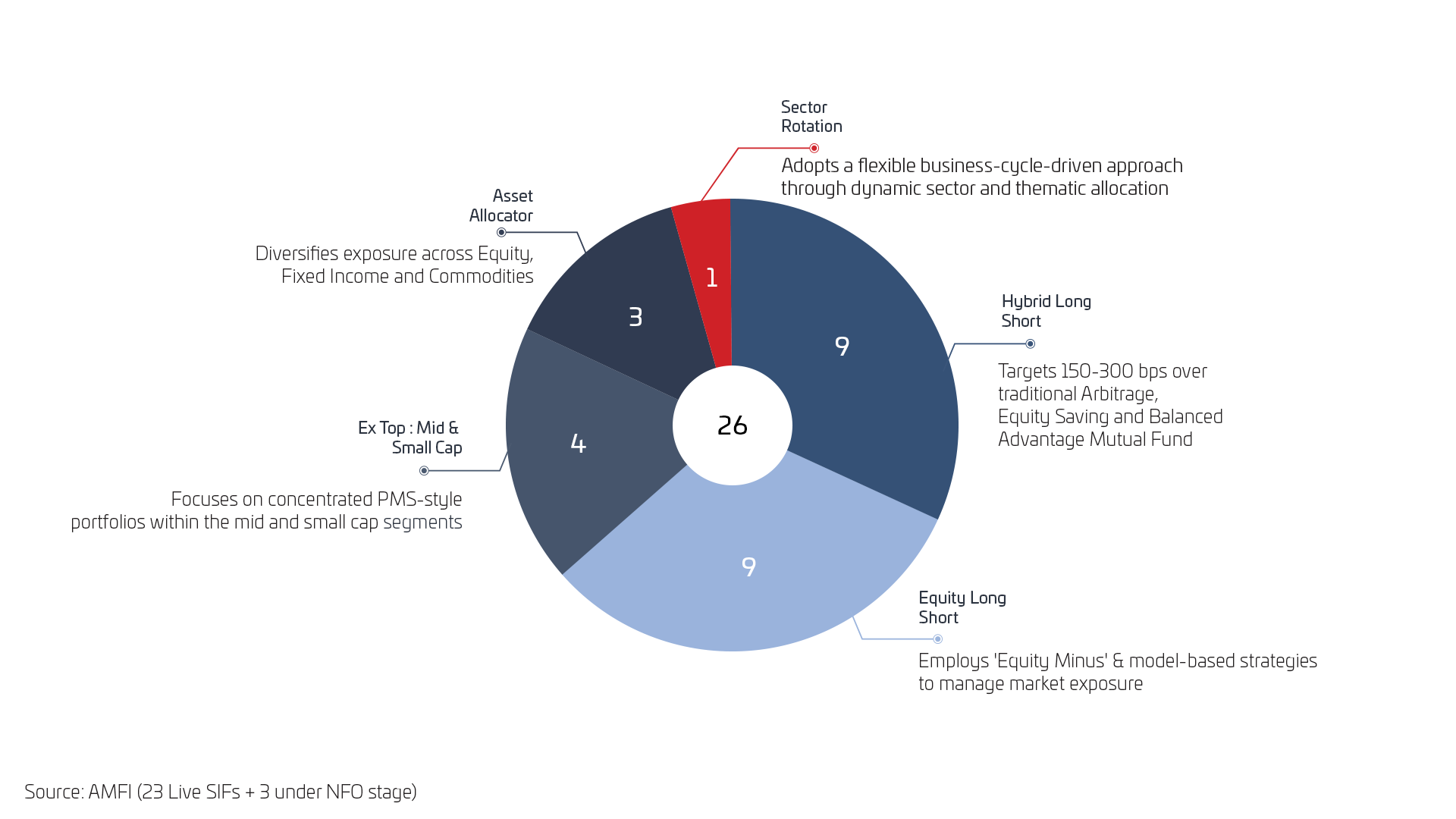
The pace of growth since launch is visible both in the breadth of strategies introduced and the rapid expansion in industry AUM.
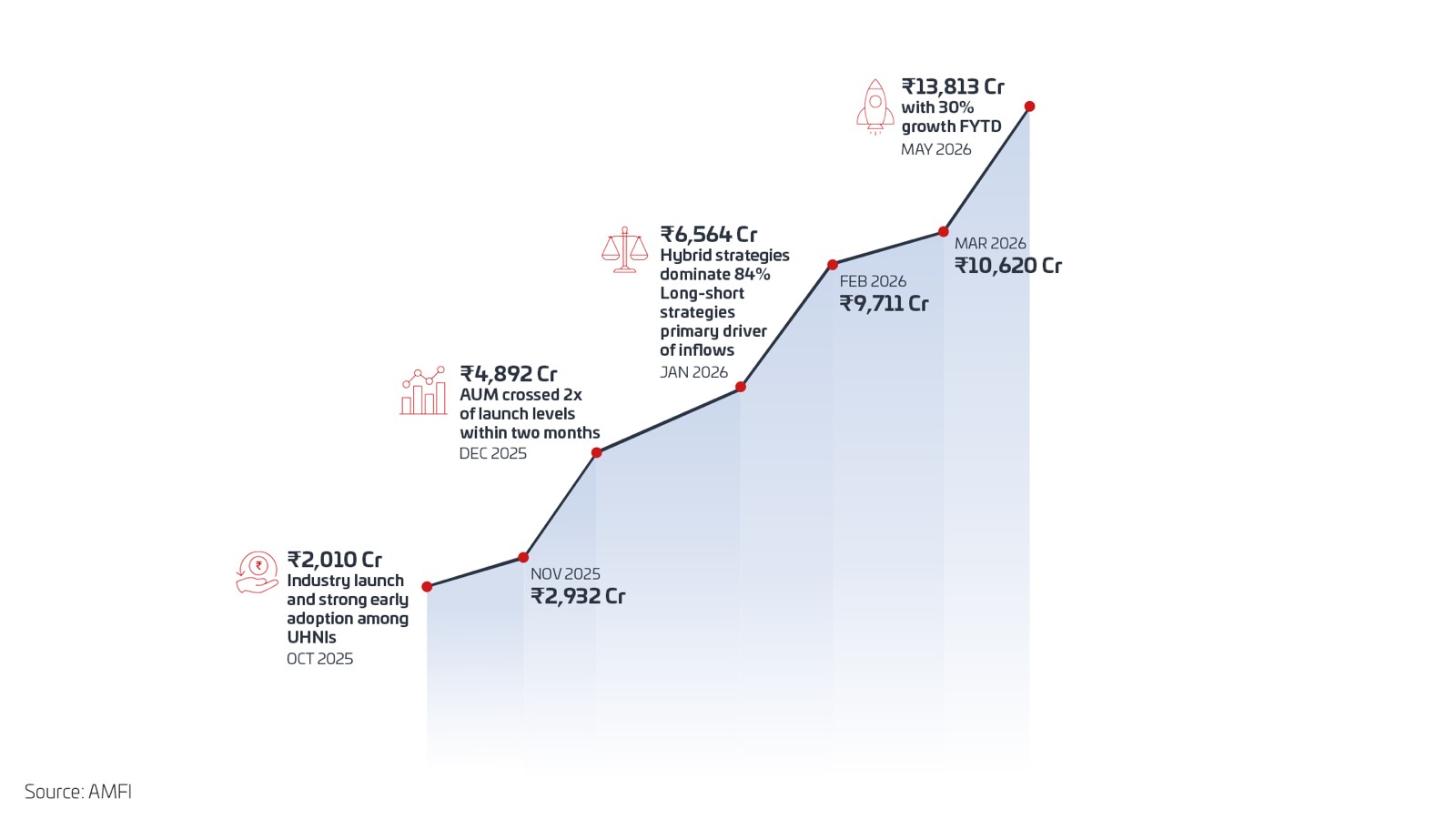
Industry AUM has grown from approximately INR 2,010 cr in October 2025 to over INR 13,813 cr by May 2026, reflecting strong early adoption among UHNIs and sophisticated investors.
Rethinking traditional debt allocation
The underlying catalyst for this shift, however, was already taking shape well before the launch of the framework.
Two tax changes significantly altered the role of traditional debt allocations within investor portfolios. The 2023 change that brought debt funds under marginal tax rates, followed by the removal of indexation benefits in 2024, materially reduced post-tax return efficiency for several fixed income-oriented allocations.
For many investors, particularly within the UHNI segment, this created a clear portfolio challenge. Traditional debt allocations, while still important from a liquidity and stability perspective, had become less efficient in delivering post-tax outcomes. The market responded with a new wave of differentiated allocation strategies.
Hybrid strategies increasingly incorporated arbitrage, equity savings and dynamic allocation frameworks to improve post-tax portfolio efficiency. This innovation evolved beyond tactical product structuring and began shaping a more differentiated investment category altogether.
Evolving portfolio structures
Over time, this shift began extending beyond tax-efficient positioning and toward more differentiated portfolio construction approaches.
Some asset managers have positioned their offerings within a balanced allocation framework, combining equity participation with active hedging and income generation strategies. Others have leaned more heavily into arbitrage-led structures aimed at enhancing tax-efficient accrual.
Within income-oriented strategies themselves, differentiation has become increasingly visible through varying credit approaches, ranging from relatively conservative high-rated accrual portfolios to more opportunistic credit-oriented positioning seeking enhanced carry.
This evolution is significant because it highlights how SIFs are being used not merely as tax-aware structures, but as tools for creating differentiated risk-return propositions across investor segments.
Several early entrants including Quant Mutual Fund, Edelweiss Mutual Fund and SBI Mutual Fund have introduced differentiated strategies across hybrid and equity-oriented categories, signalling growing conviction around the category’s long-term relevance.
Expanding the equity toolkit
A similar evolution is visible within the equity space. Most equity-oriented SIFs have adopted flexi-cap frameworks with greater allocation flexibility, with strategies such as Quant SIF, Dyna and Arudha reflecting the growing preference for more dynamic portfolio construction. Select offerings, including ITI Mutual Fund’s Diviniti strategy, have also introduced large-cap long-short approaches that were previously less accessible within traditional mutual fund structures.
More recently, sector rotation strategies introduced by players such as Quant Mutual Fund have further expanded the category’s positioning toward business-cycle-driven investing and tactical capital allocation.
Even within the relatively niche ex-top 100 category, the early traction seen in strategies such as ICICI Prudential Mutual Fund’s ISIF suggests that investors are increasingly willing to move beyond conventional large-cap exposures in pursuit of differentiated alpha opportunities.
Taken together, these developments point toward a broader shift in Indian wealth management, with investors increasingly moving toward more outcome-oriented and adaptive portfolio frameworks.
From product innovation to portfolio architecture
In many ways, SIFs represent the gradual convergence between traditional and alternative investing frameworks. The boundaries between mutual funds, dynamic allocation strategies and institutional-style portfolio construction are becoming increasingly fluid, as investors seek greater precision in managing both risk and return outcomes.
For UHNIs and family offices, this evolution is particularly relevant. As Indian private wealth matures, portfolio construction is becoming increasingly institutional in nature, with allocation decisions driven by capital efficiency, diversification of return drivers and adaptability across changing market and tax environments.
Several intersecting trends are accelerating this shift: Rising financialization of savings, growing sophistication of private wealth portfolios, greater focus on post-tax outcomes and the search for differentiated return streams in a more volatile market environment. Simultaneously, evolving regulation and broader access to institutional-style investment frameworks are making portfolio construction increasingly strategy-led rather than purely product-led.
Against this backdrop, the rise of SIFs appears less like a standalone product innovation and more like a reflection of a deeper structural transition in Indian investing.
What SIFs signal for Indian wealth
As the category matures, differentiation is likely to move beyond tax efficiency toward consistency of execution, portfolio adaptability and the ability to generate differentiated sources of alpha.
A decade ago, allocation conversations were often centred around identifying the “best-performing fund.” Today, the focus is increasingly shifting toward how different strategies interact within a portfolio, how efficiently capital is deployed and how portfolios behave across varying market conditions.
Viewed through this lens, SIFs are increasingly becoming building blocks within a more institutional, strategy-led and outcome-oriented approach to Indian wealth allocation.
For more information and important disclosures, please refer to our disclaimer.




Updates
Subscribe to our latest news, insights, opinions and more

Hi there!
Tell us a little about yourself and your communication preferences.